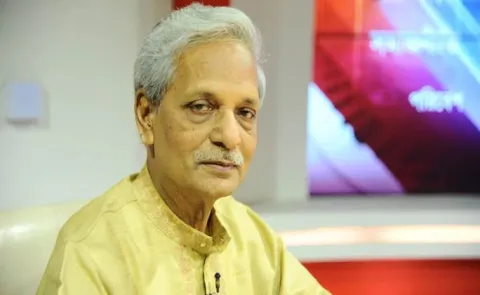
Bangladesh has officially welcomed a new government, with the swearing-in ceremony held on Tuesday at the National Parliament in Dhaka’s South Plaza. The event marked the inauguration of the cabinet led by the newly appointed Prime Minister, Tarique Rahman, chairman of the Bangladesh Nationalist Party (BNP). Notably, the new cabinet also includes a senior leader from the Hindu minority, Nitai Ray Chowdhury, which has garnered significant attention.
Nitai Ray Chowdhury is one of the 25 cabinet ministers designated by Prime Minister Rahman, and he is expected to take charge of the Ministry of Cultural Affairs, according to various reports. Chowdhury secured a remarkable victory in the national parliamentary elections held on February 12, representing the Magura-2 constituency, where he defeated his opponent from the Jamaat-e-Islami party by a substantial majority.
So, who is Nitai Ray Chowdhury? The 77-year-old leader was born in 1949 in the Magura district of Bangladesh. Professionally, he is a lawyer, having completed his primary education at Magura Government College. He later obtained a degree in law from Dhaka University, where he was actively involved in student politics, laying the foundation for his political career.
Chowdhury first entered the national parliament in 1988, elected from the Magura-2 constituency. He currently serves as the Vice Chairman of the Bangladesh Nationalist Party and has previously held ministerial positions in the sectors of education, youth, and sports. His active political engagement over the decades has made him a prominent figure within the party.
In addition to his political achievements, Chowdhury’s daughter, Nipon Ray Chowdhury, is also a notable figure within the BNP, recognized for her active leadership role. She currently serves as a member of the party’s executive committee, continuing the family’s legacy in Bangladeshi politics.
The inclusion of Nitai Ray Chowdhury in the cabinet is seen as a significant step towards promoting inclusivity in Bangladesh’s governance, especially for minority groups. As the new government takes shape, all eyes will be on how this diverse cabinet addresses the challenges facing the country and fosters an environment of unity and cooperation among its citizens.
As Bangladesh embarks on this new political chapter, the presence of leaders like Chowdhury may pave the way for more inclusive policies and representation for underrepresented communities. The coming months will be crucial in determining the direction of the new government and its commitment to fostering a multi-faceted society.