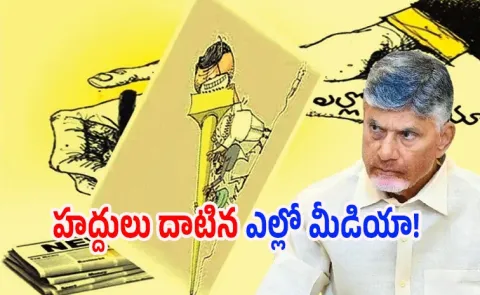
The issue of yellow media in Andhra Pradesh has reached alarming levels, with accusations of fanaticism towards former Chief Minister Chandrababu Naidu. Critics argue that the representatives of yellow media have long abandoned journalistic values, resorting to personal attacks and inappropriate language while continuously spreading venom against the current Chief Minister, Y.S. Jagan Mohan Reddy.
The controversy centers around Jagan’s remarks about the land acquisition for Amaravati’s second phase, where he stated, “There is no direction even for the first phase… They are troubling farmers again under the guise of the second phase, constructing the capital in the river basin.” During a two-hour press conference, Jagan discussed various topics, including the Bogapuram airport and Naidu’s alleged credit theft, but yellow media outlets like Eenadu and Andhra Jyothi focused solely on the term “river basin,” weaving sensational narratives from it.
Rather than addressing the substance of Jagan’s comments, critics argue that the yellow media has made an effort to divert attention from the main issues at hand. While differing opinions on these statements are welcome, resorting to derogatory language in criticism is deemed unacceptable. Notably, Jagan has long criticized Naidu, alleging that the capital was announced only after land was appropriated from farmers, a claim supported by evidence.
In the past, cases were filed against leaders of the TDP government regarding these land issues. Even the current Deputy Chief Minister and Janasena President, Pawan Kalyan, criticized the corruption surrounding Amaravati’s capital announcement, questioning the necessity of such extensive land acquisition. He has also suggested that Amaravati is evolving into a caste-based capital.
Despite the serious allegations, yellow media has never included these criticisms in their narratives. Jagan pointed out that the TDP government had earlier reported that the cost of developing roads, electricity, and drainage in the first phase of 80,000 acres was around ₹2 crores per acre. This statement cannot be deemed false. Now, with the acquisition of another 80,000 acres, the cost for infrastructure development would amount to ₹2 lakh crores, a figure consistent with Naidu’s previous claims.
Jagan has labeled the capital as a massive scam, claiming that Naidu and his associates selected the Palnadu region solely to inflate land prices. He argued that choosing the area between Vijayawada and Guntur as the capital would have accelerated its development into a metropolitan city. Many have suggested constructing government buildings on available land near Nagarjuna University, and there is a consensus against ruining fertile land that yields three crops a year.
Furthermore, the committee appointed by the central government recommended this location for the capital, but Naidu ignored it. Jagan has recently remarked that Naidu is constructing the capital in the river basin, urging the Supreme Court to take note of the matter. The land acquired from 29 villages predominantly lies between the Krishna River and other streams, raising concerns about flooding. Despite ongoing discussions, the yellow media has continued to demonize Jagan, labeling his statements as toxic.
Former Minister Vadde Shobhanadreeswara Rao also expressed that the Amaravati region is unsuitable for a capital, yet yellow media has not responded to this. When Jagan questioned why farmers remain without returnable plots, the media chose to focus on the term “river basin,” disregarding the actual concerns of the farmers. Eenadu even published extensive articles discussing which cities are located along riverbanks, but failed to address whether any of those cities had flood management schemes in place.
Critics are skeptical about whether Amaravati can set new records in flood management while incurring massive expenditures for flood management projects. Additionally, the cost per square foot for developing the capital has reportedly ranged from ₹9,000 to ₹10,000, a staggering amount.
When Jagan proposed Visakhapatnam as the executive capital, yellow media published misleading articles suggesting that the ocean was encroaching on the city. This raises the question: where are the flood management measures in Visakhapatnam? If there are concerns about flooding in Amaravati, it is often attributed to the topography and geological conditions of the area.
Yet, yellow media has been quick to vilify anyone who points out these issues, suggesting that they have committed a grave error. When a farmer expressed his distress and suffered a heart attack, media outlets like Eenadu and Andhra Jyothi failed to publish a single line on the matter. Is it a crime to express an opinion about Amaravati? This media diversion appears to be a calculated attempt to deceive the people of Andhra Pradesh, particularly the farmers of Amaravati.
By fabricating stories and spreading rumors in the name of Jagan, the yellow media aims to instill fear among farmers, creating an illusion that something disastrous may happen in Amaravati, preventing them from voicing their concerns. This manipulation of journalism to write disgraceful articles is a recurring pattern among yellow media outlets.
In conclusion, while Chandrababu Naidu has expressed that Amaravati will become a future city regardless of the challenges faced, the underlying sentiment remains that the distress of affected farmers may not resonate with government officials. The ongoing media narrative raises questions about accountability and the true intentions behind the sensational reporting.