Political dynamics in the state are undergoing a significant transformation as unexpected alliances and agreements among local parties are reshaping the municipal landscape. With the three major political parties—Congress, BRS (Bharat Rashtra Samithi), and BJP (Bharatiya Janata Party)—adopting varied strategies across different municipalities, urban politics has become increasingly intriguing. Reports indicate that Congress and BRS are collaborating in some areas, while in others, BRS and BJP are forming coalitions, and there are instances of Congress and BJP working together as well.
As the state prepares for the upcoming municipal chairperson and vice-chairperson elections on Monday, the situation is poised to be highly dynamic. In the past two days, the political equations have shifted dramatically in 36 municipalities where the “magic figure” needed for a majority has not been achieved by any single party. Some municipalities may even require a lottery to determine outcomes, while others are likely to face delays in their elections. Overall, Congress appears to have a clear majority in several municipalities, along with a potential gain of 20 more seats.
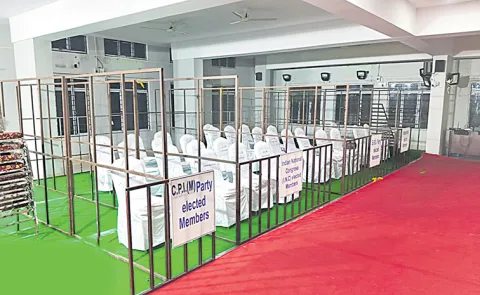
In Mahbubabad, where a magic figure of 19 members is required, Congress has secured 13 seats, while BRS has 12. Additionally, three members from the CPI(M) are backing Congress, and another three from the CPI are supporting BRS. Efforts by Congress to attract independents to reach the necessary magic figure seem promising, indicating that the chairperson position may ultimately go to Congress, although an independent candidate could also take the role.
In Torrur, the scenario is slightly different, with BRS winning 9 seats, giving it a majority in the municipality. However, Congress is strategically maneuvering by involving local MPs and MLAs in their plans, potentially leading to a tie that could necessitate a toss to decide the chairperson. Meanwhile, in Asifabad, Congress has 7 seats against BRS’s 9, but with four independents joining Congress, it appears likely that this municipality will tilt in favor of Congress.
In Khanapur, where the required magic figure is 7, both BRS and BJP have secured 4 seats each, while Congress has 3. With an independent joining Congress, the balance of power is now equal among the three parties. Negotiations regarding power-sharing are ongoing, as the potential for a tie looms large. The situation is similarly complex in Adilabad, where a coalition of BRS, Congress, and AIMIM is attempting to prevent BJP from gaining ground.
Across multiple municipalities, such as Bhainsa and Kaghaznagar, political strategies are being tested as parties vie for control. In Bhainsa, AIMIM holds 12 wards, and Congress’s support from an independent may enable a competitive race. Kaghaznagar reflects a close contest with Congress and BRS securing 9 and 11 seats, respectively, indicating that the political maneuvering will continue until the very last moment.
As the elections approach, the implications of these alliances and the shifting political landscape will play a crucial role in determining the future governance of these municipalities. The outcomes not only reflect local sentiments but also highlight the strategic adaptations of major parties in response to changing political climates. With so much at stake, the results on Monday could set the stage for a new era in urban governance in the state.