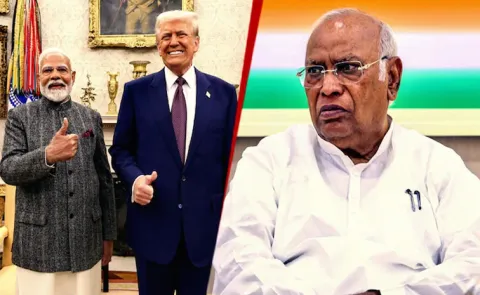
Kalaburagi (Karnataka): Congress President Mallikarjun Kharge launched a scathing attack on the ruling BJP’s stance regarding the West Asian crisis, trade agreements with the United States, and tariff issues during a program held in Chittapur, Kalaburagi district on Sunday. He characterized U.S. President Donald Trump as a dictator and Prime Minister Modi as his puppet, alleging that Trump is manipulating Modi using the Epstein files as leverage.
Kharge expressed deep concerns about the implications of U.S. actions on global peace, stating, “The U.S. has assassinated the Supreme Leader of Iran. If they can kill a national leader outright, can the world or that country ever feel safe? It could be Iran’s Khamenei or Venezuela’s Maduro; anyone could be a target. If world leaders are subjected to such intimidation, there will be no peace on Earth.” He criticized the arrogance of the U.S. for trampling on international laws and norms.
The Congress leader also accused the U.S. of pressuring India into signing trade agreements under the threat of tariffs. He claimed that the Modi-Trump alliance is detrimental to the nation, stating, “Modi and Trump are destroying our country and turning India into a vassal state of America.” Kharge’s comments come at a time when the geopolitical landscape is fraught with tension, particularly concerning U.S. interventions in other nations’ affairs.
During his address, Kharge highlighted the broader implications of U.S. foreign policy and its impact on India’s sovereignty. He argued that the Indian government should stand firm against such pressures instead of succumbing to external forces that threaten its integrity and independence. “It is essential for India to assert its position on the global stage rather than allowing itself to be bullied into submission by American interests,” he urged.
As the Congress party gears up for upcoming elections, Kharge’s remarks resonate with a growing sentiment among opposition leaders who criticize the BJP’s foreign policy. The party aims to highlight what they perceive as the government’s failure to protect India’s interests in international dealings.
In conclusion, Kharge’s statements not only reflect his party’s stance on critical issues but also serve as a rallying call for those who believe that India’s foreign policy should prioritize national sovereignty over compliance with foreign powers. The discourse surrounding these topics is expected to intensify as the political landscape evolves in the lead-up to the elections.