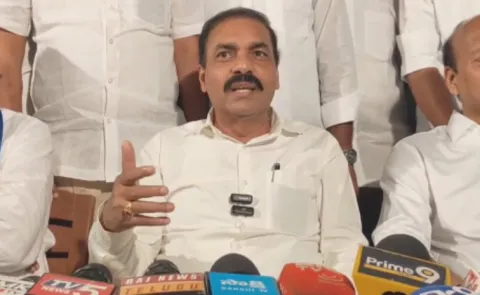
In a recent press conference held in Nellore district, YSR Congress Party leader and former minister Kakani Govardhan Reddy criticized the budget presented by the coalition government, labeling it as disastrous and lacking in essential allocations. He expressed his discontent over the absence of funds for crucial welfare programs like the ‘Aadabita Sukhibhava’ scheme and unemployment allowances, which he believes are vital for the state’s progress.
Govardhan Reddy emphasized that the five budgets introduced under the current YSR Congress Party regime have been commendable and have not faltered in their commitment to welfare, even amidst challenging situations such as the COVID-19 pandemic. He stated that these budgets have earned public approval and have shown a consistent dedication to the well-being of the people.
However, he sharply criticized the recent budget for failing to address the needs of various sectors, particularly for women and unemployed individuals. He pointed out that the allocations for the ‘Super Six’ schemes were minimal and inadequate to make a meaningful impact. “There are six lakh applications pending for the ‘Annapurna Sukhibhava’ scheme, which shows a lack of urgency in addressing the plight of farmers,” he noted, arguing that the budget is nothing short of a betrayal to the agricultural community.
Reddy further accused the government of deceiving not only farmers but also employees and workers across all sectors. He claimed that the budget serves as a reflection of the coalition government’s disregard for the welfare of the common people. “This budget can only be seen as one that perpetrates injustice against all social classes,” he stated emphatically, highlighting the widespread discontent among various communities.
As the political tensions rise with these statements, it is evident that the opposition is gearing up for a more significant confrontation regarding the government’s financial plans. The criticism from Kakani Govardhan Reddy aligns with ongoing debates about fiscal responsibility and social welfare in Andhra Pradesh. Many citizens are now left wondering how these budgetary decisions will ultimately affect their livelihoods and the state’s overall development.
The remarks from the former minister have sparked discussions among political analysts and citizens alike, questioning the effectiveness of the government’s financial strategies. With the upcoming elections on the horizon, the ruling coalition will need to address these concerns to maintain public support and trust.
In conclusion, Kakani Govardhan Reddy’s comments reflect a growing dissatisfaction with the current government budget, raising important questions about its implications for various sectors within society. As political dynamics continue to evolve, the response from the government and its supporters will be crucial in shaping the future discourse around economic policies in Andhra Pradesh.