In a heated protest that unfolded in Amaravati, leaders of the YSR Congress Party (YSRCP) accused the ruling coalition of being responsible for the murder of Dalit activist Salman. The allegations came to light during a visit to the office of the Director General of Police (DGP), where YSRCP leaders expressed their frustration over the lack of response from law enforcement regarding their complaints about Salman’s death. The party’s leaders claimed that the police behaved like members of the opposition Telugu Desam Party (TDP) instead of upholding their duty to the public.
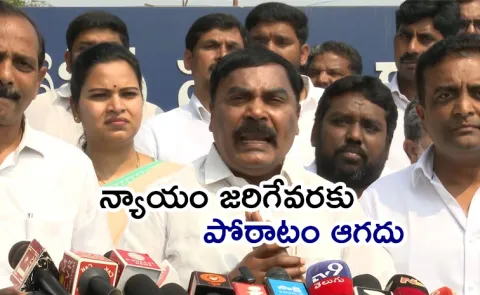
Salman was murdered recently, and his family members sought justice by filing complaints at the DGP office. However, their grievances went unheard, prompting the YSRCP leaders to stage a sit-in protest outside the DGP office. Eventually, an additional DGP agreed to accept their complaint, but only after significant pressure from the protesting leaders, which included former ministers and notable party members.
Among the leaders present were former ministers Ambati Rambabu and Vidadala Rajini, as well as several MLAs and former legislators. After their protest, they addressed the media, emphasizing that it was disgraceful for police to file cases against the deceased instead of the actual perpetrators. Former minister Merugu Nagarjuna criticized the increase in violence against Dalits since the coalition took power, asserting that the murder of Salman was a state-sanctioned killing and demanded a compensation of one crore rupees for the victim’s family.
The protestors articulated their outrage over the treatment of Salman’s family, highlighting that they were denied access to view his body and faced obstacles when attempting to file complaints. They questioned the state’s commitment to justice, suggesting that the police’s actions reflected a broader disregard for the safety of marginalized communities. Nagarjuna called for a Central Bureau of Investigation (CBI) probe into the murder, arguing that local authorities had failed to act appropriately.
Former MLA Kasu Mahesh Reddy echoed these sentiments, asserting that the state had become a hub of lawlessness, where Dalits were targeted and the police chose to ignore their pleas for help. He criticized the authorities for allegedly prioritizing political loyalty over public safety, claiming that the situation had deteriorated to such an extent that citizens felt unsafe even approaching police stations.
In response to the ongoing concerns, YSRCP leaders vowed to continue their fight for justice, insisting that they would not relent until accountability was established for Salman’s murder. They pledged to take their case to the High Court if necessary, emphasizing that their struggle was not just for Salman’s family but for the rights and safety of all marginalized individuals across the state.
The protests highlighted a growing discontent among Dalit communities in Andhra Pradesh, who feel increasingly vulnerable under the current administration. As the situation unfolds, the YSRCP remains committed to advocating for justice and protection for the most disadvantaged in society, insisting that systemic changes are needed to address the violence and discrimination faced by Dalits.