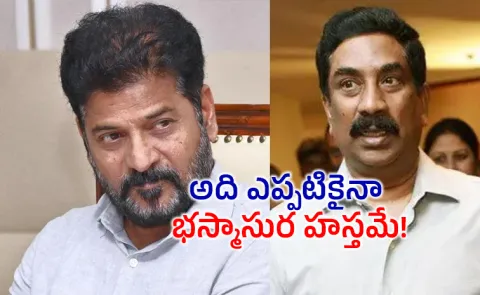
Telangana Chief Minister Revanth Reddy appears to be embroiled in a complex web of political controversy, as he finds himself both under scrutiny and inadvertently undermining his own credibility. Recent actions taken by Reddy to consolidate power over ministers within his government have raised eyebrows, leading many to question his motives and the implications for the Congress party’s internal unity.
Reddy’s remarks and decisions have sparked discussions, with critics suggesting that he is fueling discord within the Congress ranks. The media’s role in this saga has also come into focus, particularly with the Andhra Jyothi newspaper, known for its support of the Telugu Desam Party (TDP), Janasena, and BJP coalition. There are growing concerns that the newspaper’s coverage could be heavily influenced by Reddy’s briefings, leading to a perception that its controversial articles are often linked to his political maneuvering.
The situation escalated following a report aired by NTV News that was perceived as derogatory towards female IAS officers. In response, Minister Komati Reddy expressed his discontent, prompting the IAS and IPS officers’ associations to condemn the report. Although NTV issued an apology, the incident raised questions about the actions taken by law enforcement, which involved raids on the channel and the arrest of two journalists. The police’s approach has led to accusations of overreach and lack of adherence to legal protocols.
As political tensions mounted, Andhra Jyothi’s owner Radhakrishna reignited the controversy with a provocative article, implicating Deputy Chief Minister Mallu Bhatti Vikramarka in a corruption scandal linked to coal tenders. Allegations surfaced that Reddy altered rules for the benefit of certain companies, igniting further debate about the integrity of the Telangana government. Critics argue that such narratives are not only damaging to individual reputations but also contribute to a wider perception of corruption within the administration.
Reddy’s failure to address these allegations promptly raised suspicions about his leadership. Observers noted that his silence during key moments, particularly when the NTV report aired and during Komati Reddy’s outcry, was telling. The absence of a timely response has led to speculation that he may have been complicit in the unfolding drama, raising further questions about his political acumen.
In a bid to cleanse the political atmosphere, Reddy has urged ministers to avoid disparaging remarks and emphasized that there is no corruption within his government. Meanwhile, Vikramarka’s announcement to cancel the controversial tenders hinted at a power struggle, with claims that organized criminals are attempting to exploit Telangana’s resources.
Reddy’s recent statements reflect a growing concern that his political survival is intertwined with the narrative being spun by Radhakrishna. By urging that no articles should benefit the BRS party, he is likely attempting to mitigate the damage and maintain his standing within the Congress party. However, his remarks also imply an awareness of the precarious nature of his position, as he navigates the turbulent waters of Telangana politics.
As this political saga continues to unfold, it is apparent that the internal dynamics of the Congress party are under strain. The potential fallout from Reddy’s actions and the media’s portrayal could have lasting implications for the party’s future in Telangana. Observers will be closely monitoring how these events will influence not only Reddy’s political career but also the broader landscape of Telangana politics.